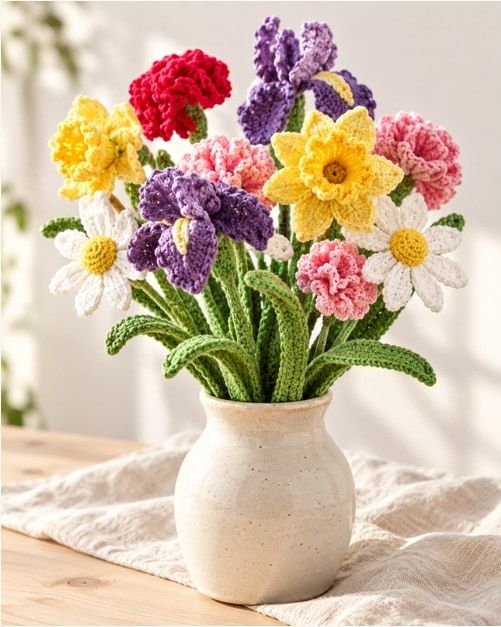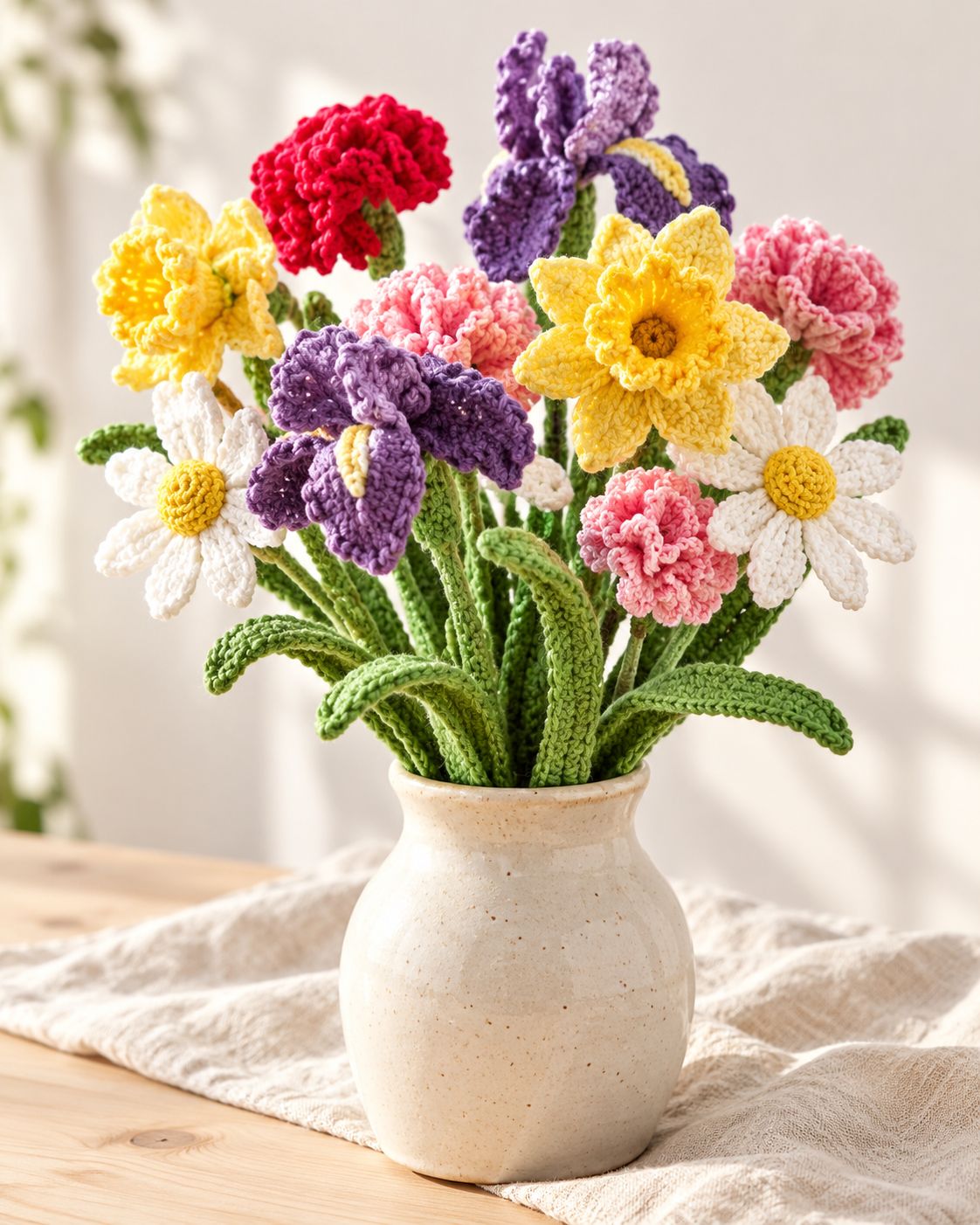
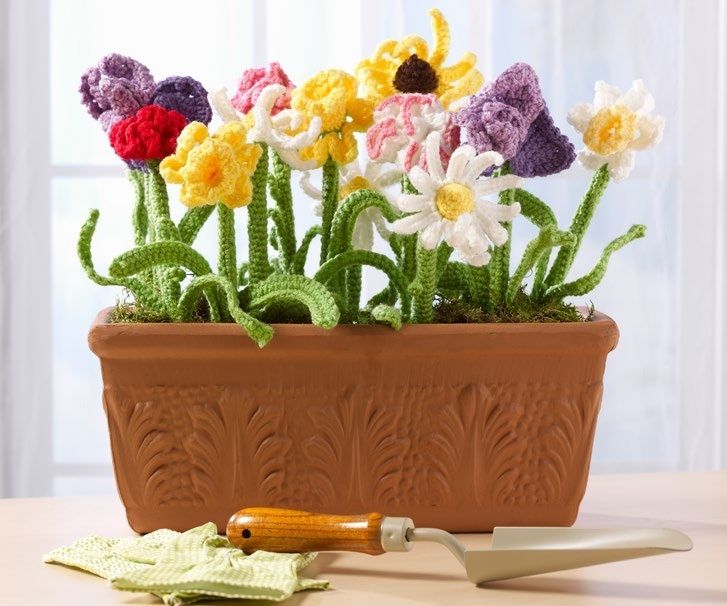
Make a mixed bouquet from four different flowers: a wiggly-crochet carnation, a daffodil with a separate corona cup, a daisy and an iris with upper and lower petals. Each has its own head and supported stem. Read the flower-specific instructions together with the colour key before choosing which stems to make.
Before you begin
Make four kinds of flowers: carnation, daffodil with a corona cup, daisy and iris. Each flower has a head and a supported stem. The written instructions include their leaves and finishing. Read all notes before starting. These are decorative flowers with wooden and wire supports. Choose your flower colours using the lettered yarn key on the materials page.
Materials and abbreviations
Medium / worsted-weight acrylic yarn: one skein each of A spring green, B pink, C soft white, D bright yellow, E lavender, F orchid purple and G coffee brown. Solid skeins: 198 g / 7 oz, 333 m / 364 yd. Multicolour / heather / print skeins: 141 g / 5 oz, 223 m / 244 yd; flecked skeins: 141 g / 5 oz, 238 m / 260 yd. Hooks: 3.75 mm (smallest), 4 mm (medium), 5 mm (largest), or sizes needed for gauge. Also: yarn needle, stitch marker, one 20.5 cm / 8 in chopstick for each flower, and 15 cm / 6 in chenille stems for carnation, daffodil and iris leaves. Gauge: 7 sc and 8 rows = 5 cm / 2 in in pattern, using the largest hook. Adjust hook size so the wooden support is held snugly inside the stem.
This pattern uses US crochet terms.
| A, B, C | colour A, colour B, colour C, etc. |
|---|---|
| ch | chain |
| dc | double crochet |
| hdc | half double crochet |
| sc | single crochet |
| sp(s) | space(s) |
| st(s) | stitch(es) |
| tr | treble (triple) crochet |
| ( ) | work directions in parentheses into the same stitch |
| [ ] | work directions in brackets the stated number of times |
| * | repeat what follows as indicated |
Pattern
| Flower | Width | Height |
|---|---|---|
| Carnation | 7.5 cm / 3 in | 20.5 cm / 8 in |
| Daffodil | 10 cm / 4 in | 21.5 cm / 8.5 in; cup 5 cm / 2 in deep |
| Daisy, petals spread | 12.5 cm / 5 in | 16.5 cm / 6.5 in |
| Iris | 7.5 cm / 3 in | 21.5 cm / 8.5 in |
Special Stitches
reverse sc (reverse single crochet) = Work single crochet in opposite direction from which you would usually work (left to right if you are right-handed and right to left if you are left-handed). This stitch is also known as crab stitch. It creates a rope-like twisted single crochet edging. sc2tog = [Insert hook in next stitch, yarn over and pull up a loop] twice, yarn over and draw through all 3 loops on hook.
Notes
1. Each flower is made from 2 sections: head and stem. 2. For pieces worked in continuous rounds (spirals), you may find it helpful to place a stitch marker at the beginning of the first round and move it up as each round is completed. 3. Carnation petals are worked with a “wiggly crochet” technique. First, you will create a grid base, then you will work stitches around the posts of the stitches and in the chain spaces. 4. Daisy is shown in 2 colorways. Begin head in the color of your choice. 5. Stem is made to fit an 8” (20.5 cm) chopstick (so flower can stand in soil or floral foam); you may need to adjust the length if you use a longer or shorter chopstick. Always insert wide, blunt end of chopstick in stem so narrow, pointed end can stand in soil. Check your gauge as you work so that chopstick is held snugly in the stem.
Carnation
Carnation stem
With medium hook and A, ch 26.
- Row 1 (wrong side)Sc in second ch from hook and in each ch across, turn; 25 sc.
- Row 2Ch 1, sc in first 10 sc, ch 7, slip st in 2nd ch from hook and in next 5 ch (leaf made), sc in next 10 sc, ch 7, slip st in 2nd ch from hook and in next 5 ch (leaf made), sc in remaining sts, turn; 25 sc and 2 leaves.
- Row 3Ch 1, sc in each st, turn; 25 sc.
- Row 4Ch 1, sc in first 10 sc, [ch 7, slip st in 2nd ch from hook and in next 5 ch (leaf made), sc in next 5 sc] twice, sc in remaining sts, do not turn; 25 sc and 2 leaves.
- Row 5Working across ends of rows, sc in each row, do not turn; 4 sc. Note: Continue in rounds.
- Round 6Working in front of sts of Row 5, sc in 4th st from the hook (to form a ring), sc in remaining 3 sts. Place marker for beginning of round and move marker up as each round is completed.
- Round 7Working in outer loops only, 2 sc in each st; 8 sc.
- Round 8[2 sc in next st, sc in next st] 4 times; 12 sc.
- Round 9[Dc in next st, sc in next st] 6 times; join with slip st in first dc; 6 dc and 6 sc. Fasten off, leaving a long tail for sewing.
Carnation head
Carnation grid base
With largest hook and B, ch 4.
- Round 1[Dc, ch 1] 5 times in 4th ch from hook (beginning ch count as dc, ch 1); join with slip st in 3rd ch of beginning ch; 6 dc and 6 ch-1 spaces. Note: You will now join grid base to stem.
- Round 2Insert hook in inner loop of any st in Round 9 of stem and working through both loops of first dc, sc in first dc; working through inner loops only of each sc in Round 9 and both loops of last round, sc in each dc and ch-1 space around; 12 sc.
- Round 3Ch 4 (counts as dc, ch 1), (dc, ch 1)in each st; join with slip st in 3rd ch of beginning ch; 12 dc and 12 ch-1 spaces.
Carnation petals
Ch 3.
- Row 1Working 3 sts around post of each dc, 2 sts in each ch-1 space, and 1 st around post of each sc, alternate dc and hdc in a snake- like fashion up and down the grid base. Fasten off. Note: To simulate a carnation’s many petals, randomly (ch 2, slip st around next post or in ch-1 space, ch 3), then continue working dc and hdc along the grid base.
- Row 2 (optional)*Working in front loops only, join 2nd color in first st of any petal, slip st loosely in each st to end of petal. Fasten off. Repeat from * as many times as desired.
Carnation leaves
With medium hook and A, ch 26.
- Row 1Slip st in 2nd ch from hook, slip st in next st, working over chenille stem, sc in each ch. Fasten off, leaving a long tail for sewing.
Carnation finishing
Trim chenille stem as needed. Whipstitch leaves to base of stem. Bend leaves to desired curve. Weave in ends. Insert chopstick in stem.
Daffodil
Daffodil stem
With medium hook and A, ch 26.
- Row 1 (wrong side)Sc in 2nd ch from hook and in each ch across, turn; 25 sc.
- Row 2Ch 1, sc in each st, turn.
- Row 3Ch 3, sc in 2nd ch from hook and in next ch, sc in each st, turn; 27 sc.
- Row 4Ch 1, sc in each st, do not turn. Note: The last 2 stitches of Row 4 and all 4 stitches of Row 5 will form a ring on which the head is made. These 6 stitches will lean at an angle from the stem so the daffodil will face forward.
- Row 5Working across ends of rows, sc in each row, turn; 4 sc. Note: Continue in rounds.
- Round 6Working in front of sts of Row 5, sc in 6th st from the hook (to form a ring), sc in remaining 5 sts; 6 sc. Place marker for beginning of round.
- Round 7Work 2 sc in each st; join with slip st in first st ; 12 sc. Fasten off, leaving a long tail for sewing.
Daffodil head
Daffodil petals
- Round 1Join D with slip st in outer loop of any st of Round 7; working in outer loops only, [ch 4, slip st in next 2 st] 5 times, ch 4, slip st in next st; 6 ch-4 spaces.
- Round 2(Sc, ch 2, dc, 2 tr, ch 3, slip st in 3rd ch from hook, tr, dc, ch 3, slip st) (petal made) in each ch-4 space; join with slip st in first st; 6 petals. Fasten off, leaving a long tail to make stamens.
Daffodil corona cup
With medium hook and D, ch 2.
- Round 1Work 6 sc in 2nd ch from hook; 6 sc. Place marker for beginning of round and move marker up as each round is completed.
- Round 2Work 2 sc in each st; 12 sc.
- Round 3Working in unworked inner loops of Round 1 of petals and both loops of previous round, sc in each st.
Rounds 4 to 6: Sc in each st.
- Round 7[Sc in next st, sc2tog] 4 times; 8 sc.
- Round 8(Sc, dc, sc) in each st around; join with slip st in first st; 24 sts. Fasten off, leaving a long tail to make stamens. Weave in ends of petals and corona cup and pull up through center of corona cup. Trim to height of corona cup. Place chopstick on stem and whipstitch edges together.
Daffodil leaves
With medium hook and A, ch 26.
- Row 1Sc in 2nd ch from hook and in each ch across, turn; 25 sc.
- Row 2Ch 1, sc in each st around chenille stem to last stitch, slip st in last st. Fasten off, leaving a long tail for sewing.
Daffodil finishing
Trim chenille stem as needed. Whipstitch leaves to base of stem. Bend leaves to desired curve. Weave in ends. Insert chopstick in stem.
Daisy
Daisy head
With smallest hook and D or G, ch 2.
- Round 1 (right side)Work 6 sc in 2nd ch from hook; 6 sc. Place marker for beginning of round and move marker up as each round is completed.
- Round 2[2 sc in next st, sc in next 2 st] twice; 8 sc.
- Round 3Work 2 sc in next st, [2 sc in next st, sc in next st] 3 times, 2 sc in next st; 13 sc.
- Round 4Working in back loops only, sc in each st; join with slip st in first st. Fasten off.
- Round 5Join C with slip st in front loop of any st, ch 10, slip st in 2nd ch from hook, sc in next ch, hdc in next 7 ch, slip st in same st as join (petal made), *working in front loop only, slip st in next st, ch 10, slip st in 2nd ch from hook, sc in next ch, hdc in next 7 ch, slip st in same st (petal made); repeat from * around; join with slip st in first st; 13 petals. Fasten off.
Daisy stem
- Round 6 (right side)Join A with slip st in any unworked loop of Round 4, ch 2 (counts as first hdc), hdc in each loop around; join with slip st in top of beginning ch; 13 hdc. Place marker for beginning of round and move marker up as each round is completed.
- Round 7Sc in next st, [sc2tog] 6 times; 7 sc.
- Round 8Working in back loops only, sc in each st.
Rounds 9 to 25: Sc in each st.
- Round 26Ch 4, 2 hdc in 2nd ch from hook, sc in next 2 ch (leaf made), sc in each st; 7 sc and 1 leaf.
- Round 27Holding leaf down against stem and working behind, sc in each st; 7 sc.
Rounds 28 to 33: Sc in each st.
- Round 34Slip st in next st, [ch 15, 2 dc in 3rd ch from hook, dc in next 3 ch, hdc in next 6 ch, sc in next 3 ch (leaf made), slip st in next 2 sts] 3 times; 7 slip sts and 3 leaves.
- Round 35Slip st in first slip st, [working across opposite side of ch of leaf, sc in first 12 ch, 2 sc in next 3 ch, 2 sc in next dc, sc in next 13 st, 2 slip st in next 2 slip sts] 3 times; join with slip st in first slip st. Fasten off.
Daisy finishing
Weave in ends. Stiffen petals and leaves to straighten, if desired. Insert chopstick in stem. Continued...
Iris
Iris stem
With medium hook and A, ch 26.
- Row 1 (right side)Sc in 2nd ch from hook and in each ch across, turn; 25 sc.
Row 2 to 4: Ch 1, sc in each st, turn.
- Round 5Working across ends of rows, ch 1 [sc in first row, 2 sc in next row] twice; join with slip st in first st; 6 sc. Fasten off, leaving a long tail for sewing. With wrong sides together, fold stem lengthwise and sew edges of Rows 1 and 4 together.
Iris head
Iris lower petals
With D, ch 2.
- Round 1 (right side)Work 6 sc in 2nd ch from hook; 6 sc. Place marker for beginning of round and move marker up as each round is completed.
- Round 2Holding Round 1 of head to Round 5 of stem and working through both thicknesses, inserting hook through next st of Round 1 and then inserting in next st of Round 5 from inner side, sc in each st.
- Round 3Working in inner loops only, sc in each st. Note: Continue in rows.
- Row 4Working in outer loops only, 2 sc in next two stitches; leave remaining sts unworked, turn; 4 sc.
Rows 5 to 9: Ch 1, sc in each st, turn.
- Row 10Ch 1, sc in first st, dc in next 2 st, sc in last st; working across ends of rows, work 7 slip sts evenly to Round 3, do not turn; 2 sc and 2 dc.
Rows 11 to 24: Repeat Rows 4 to 10 twice.
Iris ruffle edge
- Row 25Ch 1, working across ends of rows and in each st, (sc, dc) in each row and st evenly around every petal. Fasten off, leaving a long tail to make stamens.
Iris upper petals
- Round 1With medium hook and working in unworked loops of Row 4 of lower petal, join F with slip st 2nd unworked loop behind first petal, ch 1, (sc, dc) in same st as join, (dc, sc, slip st) in next st, *(sc, dc) in next st, (dc, sc, slip st) in next st; repeat from * once; join with slip st in first sc; 6 sc and 6 dc. Note: Continue in rows.
- Row 2Ch 3 (counts as first dc), sc in first dc, skip next sc, sc in next dc, dc in next sc; leave remaining sts unworked, turn; 2 sc and 2 dc.
Rows 3 to 5: Ch 1, sc in each st, turn; 4 sc.
- Row 6Ch 1, sc in first st, dc in next 2 st, sc in last st; working across ends of rows, work 7 slip sts evenly to Round 1, do not turn. Skip the slip st at the bottom.
Rows 7 to 11: Repeat Rows 2 to 6.
Rows 12 to 16: Repeat Rows 2 to 6.
Iris ruffle edge continued 2
- Row 17Work same as Row 25 of lower petals.
Iris leaves
With A and medium hook, ch 26.
- Row 1Sc in 2nd ch from hook and in each ch across, turn; 25 sc.
- Row 2Ch 3, slip st in 2nd ch from hook, sc in next ch, working over chenille stem, sc in remaining sts. Fasten off, leaving a long tail for sewing.
Iris finishing
Using photograph as a guide, weave ends of D and F to center of flower to create stamens. Trim to desired length. Sew leaves to base of stem. Weave in ends. Insert chopstick in stem.
The stem gauge should hold the blunt end of an 8 inch chopstick snugly. The narrow pointed end faces down, as described in the PDF.
Does the pattern include all four flowers?
Yes. The written instructions cover carnation, daffodil, daisy and iris heads, their stems, leaves and finishing.
How to download the free PDF
Select “Download free PDF” in the download card below to save the 9-page file. Your browser may save it straight away or offer a location. If it opens in a PDF viewer, use that viewer’s download or save control. No account or email signup is required.
The cover is an illustration of the design. Any construction photographs shown are taken from the approved pattern PDF.
More patterns to explore
Browse Flowers and bouquets. Daisy Bouquet. Rose Bouquet. Large Red Rose.